Breaking Down Barriers to Make Neurofibromatosis Research Tools Accessible and Effective
Curing NFMay 26, 2026
May is Neurofibromatosis (NF) Awareness Month, a time to raise awareness about NF and the important research being done to bring more personalized and effective treatments to NF patients worldwide. At Gilbert Family Foundation, we remain committed to advancing NF research and bringing the scientific community closer to a cure. Our ongoing collaboration with Sage Bionetworks exemplifies this commitment, representing a powerful partnership that continues to change how neurofibromatosis researchers access and utilize the tools they need to advance their work.
In 2025, Gilbert Family Foundation launched a five-year investment to strengthen the Neurofibromatosis Research Tools Central (NFRTC) database and the NF Data Portal. NFRTC is an open-access catalog of vital experimental resources – think cell lines, animal models, and algorithms – designed to prevent duplicated effort and accelerate NF research. Both NFRTC and the NF Data Portal are powered by Sage Bionetworks’ Synapse platform, which supports researchers worldwide and manages over 5 petabytes of biomedical data. As a dedicated subset of this massive infrastructure, the NFRTC and NF Data Portal currently hosts over 300 terabytes of NF-specific data.
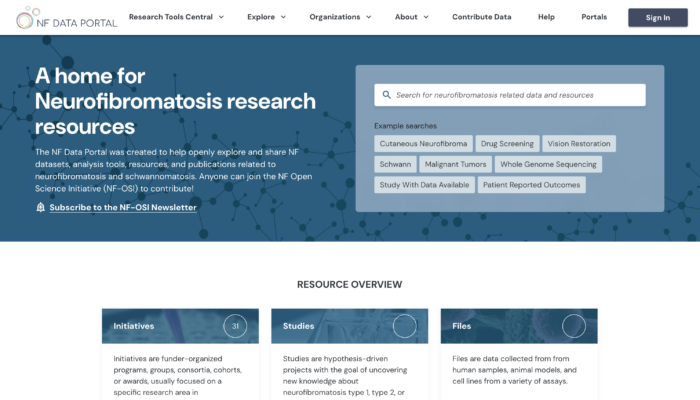
The goal of the investment was to develop a comprehensive, disease-specific research platform that integrates advanced search technologies, artificial intelligence, research tool validation mechanisms, and curated data on preclinical models to help researchers more effectively identify and utilize the resources they need. Through the expanded investment, the platform enables researchers across the globe to rapidly identify, evaluate, and access critical resources for studying NF1, NF2, schwannomatosis, and related conditions.
One of the most valuable aspects of this partnership is its focus on addressing the real challenges NF researchers face daily. Annual scientific workshops and ongoing user research ensure the platform evolves directly with the needs of NF scientists. This commitment to community-driven development keeps the platform nimble and adaptable to the rapidly changing landscape of artificial intelligence and scientific infrastructure.
Advanced features of NFRTC funded by this investment include AI-powered literature mining that automatically identifies new research tools from scientific publications, comprehensive tool comparison capabilities, and personalized user experiences that help each researcher discover the most relevant resources for their work. Similarly, an intelligent notification system will alert researchers about newly available tools and updates relevant to their specific interests, while visual comparison frameworks enable side-by-side analysis of different experimental approaches.
Finally, a particularly significant innovation planned is the comprehensive expert validation program that establishes certification standards—a “quality seal” approach that enables the research community to quickly identify tools that experts have reviewed scientifically. This will address a longstanding challenge in biomedical research where the reliability and reproducibility of research tools vary significantly, potentially saving researchers from costly experimental failures.
The platform also integrates cutting-edge resources developed through our major research initiatives, including organoid and assembloid resources—mini organ-like assemblies in a dish that revolutionize drug discovery—along with patient-derived xenografts and humanized model systems with detailed protocols and characterization data. As the Nick Gilbert Neurofibromatosis Research Institute (NGNRI) continues to build out its infrastructure for a 2027 opening, the platform will work seamlessly to ensure new data and insights are rapidly disseminated across the NF research community.
Importantly, the platform is freely accessible to researchers worldwide, embodying our commitment to open science and collaborative discovery. By lowering barriers to accessing and understanding available research tools, and by helping researchers quickly identify validated, high-quality resources, this partnership makes a critical investment in the foundational infrastructure that supports NF research—from basic biology to clinical trials.