Unfolding Detroit’s Stories
Building OpportunityArts & CultureSep 13, 2026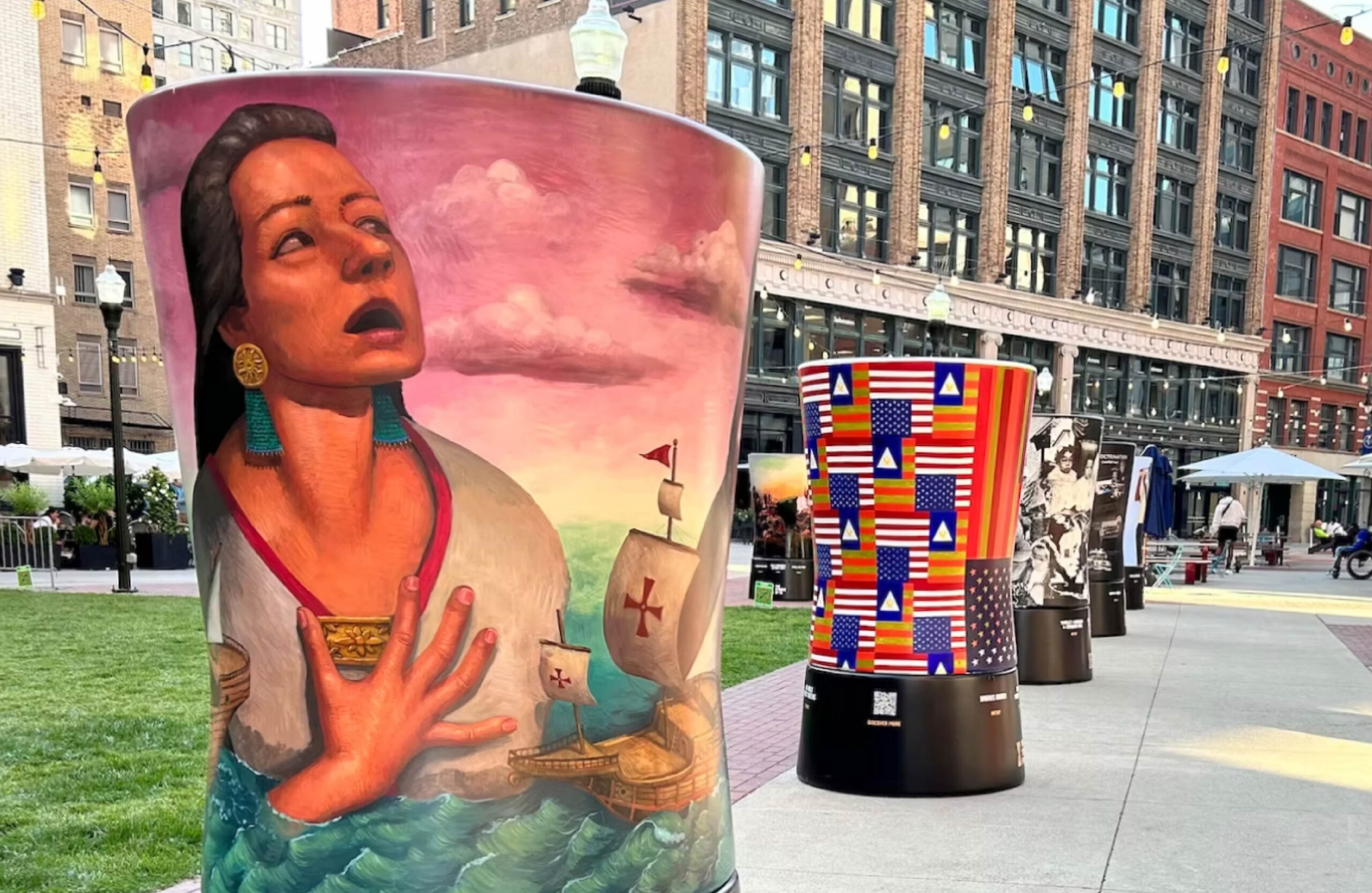
The following is a guest blog post from Ashley Shaw-Scott Adjaye, the Co-founder and CEO of The Stories of Us, a public art and storytelling initiative that invites people to share their experiences, perspectives, and hopes as part of a broader American story. Through art, storytelling, and public spaces, it explores ten narrative themes that help us reflect on our past, understand our present, and imagine our shared future. At its heart is the belief that storytelling can build belonging, connection, and civic imagination by creating space for many different experiences to be heard and shared. Gilbert Family Foundation invested in The Stories of Us Artist Collective programming led by 11 Detroit-based artists, as well as their storytelling project in partnership with the Detroit Public Library. All events take place across Detroit from July to December. This initiative reaffirms our commitment to creating access to the arts for Detroiters and cultural spaces that make Detroit so unique, while supporting local artists, thriving public spaces and the resilience of Detroit neighborhoods and beloved institutions.
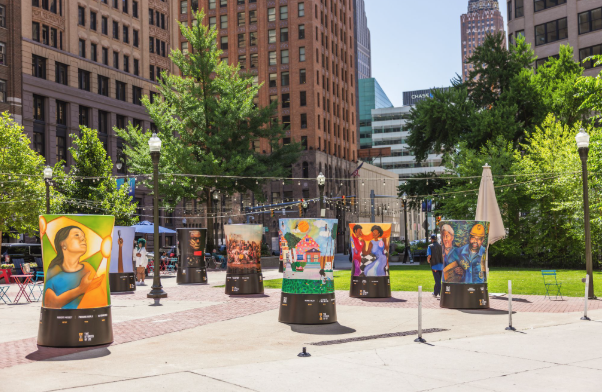
In 2024, Detroit was the first host city for The Stories of Us Talking Drum public art exhibition. At that time, we were invited by Bedrock to exhibit our storytelling totems across the city. What I didn’t know then was that Detroit and Detroiters would become part of our bedrock, foundational to the development and evolution of our storytelling organization.
We operate at the intersection of art and storytelling in public spaces – in person and online – to foster connections between artwork, artists, audiences, and place. Our mission is to inspire a culture of storytelling that sparks our shared civic imagination, expanding what stories are told, and who tells them. This year, we returned to Detroit for two more firsts: launching our digital storytelling platform and our Artist Collective Bureau.
We believe civic participation begins with being seen. Public space shapes who feels visible, whose experiences are acknowledged, and who belongs within the national story. We chose to come back to Detroit because our Talking Drum public sculptures had been widely embraced and because we knew we had only scratched the surface of Detroit’s stories with our first exhibition.
While installing our Talking Drum sculptures in Capitol Park in 2024, a woman stopped in front of Shirley Woodson’s and Senghor Reid’s piece. She said she recognized some of the photos in the piece. She stayed to tell me a story about growing up in Detroit. Our Talking Drum literally invited her to talk to a complete stranger about a personal story. It felt like a Eureka moment! This interaction reinforced that the next step in our evolution should be collecting the incredible stories that our sculptures were surfacing.
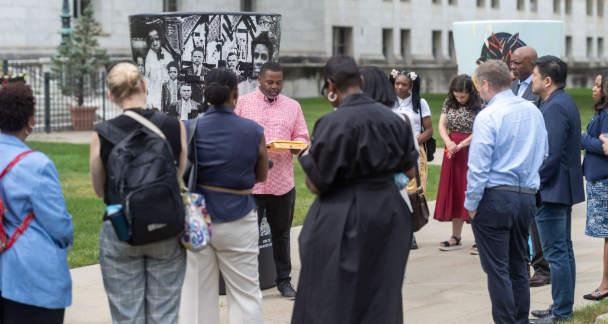
In early July, the United States celebrated its 250th birthday – a milestone we marked with the installation of our Talking Drum public sculpture at the Detroit Public Library Main Library. Libraries are among the most trusted civic institutions, places where people gather not only to learn, but to connect with one another. It was fitting that we chose this location to introduce our bilingual storytelling platform. More than an archive of stories, our platform is a civic gathering place where people can share experiences, learn from one another, discover common ground, and contribute ideas for a collective future.
The experience is straightforward because we wanted to lower the barriers to storytelling. Participants simply go to our website or scan a QR code on the sculptures and they select a storytelling prompt. They click record and respond to the prompt by speaking. Within minutes, spoken reflections are shaped into a story text using speech-to-story technology, and that text is emailed to the participants to review, edit, approve for our collection. Currently, we offer this platform in English or Spanish, with additional languages planned.
Again and again, as we’ve recorded stories, people shared a similar response: “No one has ever asked me that before.” That simple moment reinforces something important. Communities are not lacking stories. They’re often lacking invitations to share them.
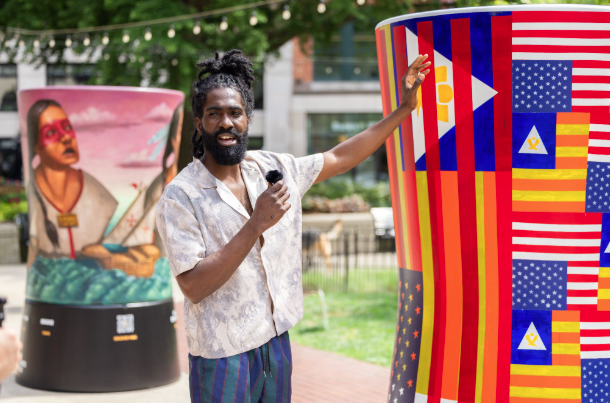
In addition to the storytelling platform, we are offering creative spaces for people to consider their civic identity through our Artist Collective Bureau. This initiative, which we piloted at the Detroit Public Library Main Library, offers small grants to our commissioned Talking Drum artists to create free public programming related to themes from their sculptures.
Inspired by his piece, On My Mama’s Side, a deeply personal statement of lineage and survival, artist Darius Baber invited the public to answer the question: What does it mean to be American when we are all composites of other places? In his hands-on workshop, participants hand-bound their own journals and decorated covers using vintage Detroit cartography, global textiles, and historical flags. Unsurprisingly, his event was over subscribed. There was a palpable excitement to having a space to create and imagine alongside an artist and in community.
This fall, one Talking Drum sculpture will be located at five Detroit Public Library branches: Conely, Edison, Main Library, Reford, and Wilder. Each location becomes both a place to encounter an artist’s story and an invitation to share your own. Alongside the sculptures, we’ll offer storytelling workshops across the five branches. We’re commissioning Detroit-based storytellers to create story circle workshops that invite community members to reflect on their experiences, share stories with one another in person, and, if they choose, share them through the storytelling platform. Much like the Artist Collective workshops, we hope these story circles bring people together in shared spaces to build connection.
But the workshops are only one part of the invitation. The digital platform remains available year-round, both at participating library branches and from home. Someone might encounter a sculpture at their neighborhood branch, participate in a story circle, or discover a prompt online months later. Each offers a different pathway into the same civic storytelling space.
As we grow, our ambition is to help civic institutions continuously learn from the people they serve, beginning where people live, gather, and belong – like public libraries. We also want to create an ongoing way for people to be heard beyond any single gathering.
That is ultimately what civic listening means to us: not asking people what they think once, but creating the infrastructure and invitations for communities to keep telling us who they are, what they have experienced, and what they imagine for the future.
As we roll out our current pilots and develop a civic listening infrastructure, we feel immense gratitude for Detroiters’ enthusiasm and the support we received from the Gilbert Family Foundation. This partnership expands access to art across the city, offers genuine space for civic imagination for both artists and the public, and reinforces that Detroiters’ stories matter. As we continue to rethink what civic storytelling can look like, we’re grateful that Detroit remains a place where we can keep building, listening, and learning alongside the communities that have helped shape our work.
We invite you to sign up for a Detroit Public Library story circle or visit the stories of us website to share your story.